Deep in the misty hills of the Virunga Mountains and the dense Bwindi Forest lives one of the most awe-inspiring and critically endangered animals on Earth: the mountain gorilla.
With their thick black fur, powerful build, and soulful eyes, mountain gorillas may seem intimidating at first—but these are peaceful, intelligent beings with deep emotional bonds and a social life that reminds us of our own.
Endangered – but not forgotten
Mountain gorillas belong to the species Eastern Gorilla (Gorilla beringei) and are one of its two subspecies. With only about 1,000 individuals left in the wild, they are classified as critically endangered by the IUCN.
Their greatest threats include:
-
Habitat loss due to deforestation and agriculture
-
Disease, especially those transmitted from humans (such as respiratory infections)
-
Poaching, even if gorillas are not always the direct target
-
Conflict and political instability in their native regions (like the DRC)
But there’s hope: Thanks to intensive conservation efforts—such as ecotourism, ranger patrols, and veterinary care provided by projects like the Mountain Gorilla Veterinary Project—the population has stabilized in recent years.
🐵 Did you know…?
🌿 Gorillas are vegetarians.
They eat over 100 types of plants, mainly leaves, stems, and fruit.
🦴 Every gorilla has a unique nose print.
Researchers use these nose patterns like fingerprints to tell individuals apart.
💪 A silverback can weigh more than 180 kg (400 lbs).
Despite their strength, male gorillas are peaceful and avoid conflict whenever possible.
🗣️ Gorillas use over 20 distinct sounds to communicate.
They also use facial expressions, gestures, and body language—just like we do.
🧬 They share 98% of their DNA with humans.
Their behavior—comforting, playing, mourning—often feels startlingly familiar.
🎨 About the mountain gorilla baby drawing
When I chose to draw a baby mountain gorilla, I knew I wanted to capture something special—not just its soft fur or body posture, but that unique expression of curiosity and vulnerability so typical of young animals.
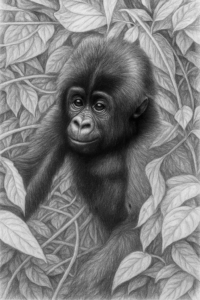
I used many fine layers of pencil to build up the dense coat, aiming to reflect the thick fur that protects gorillas from the cold mountain climate. But most important to me was the look in its eyes—calm, alert, and full of emotion.
This drawing isn’t just a portrait; it’s meant as a quiet call to action:
Look closely. Understand. Protect.
💚 What we can do
You might wonder: What can I do from so far away?
The answer is—more than you think:
-
Raise awareness—share information and educate others
-
Support conservation groups, such as:
-
Dian Fossey Gorilla Fund
-
WWF
-
Berggorilla & Regenwald Direkthilfe
-
-
Encourage responsible tourism—seeing a gorilla in the wild is unforgettable and helps fund protection.
🌍 In conclusion
The mountain gorilla is a symbol of hope—and of our shared responsibility. That it still survives in the wild today is no accident, but the result of decades of tireless and often dangerous conservation work.
With every pencil stroke, every article, every donation, and every conversation, we can help ensure that these gentle giants continue to walk through the misty forests of Africa.
🧠 More Fun Facts about Mountain Gorillas
🛏️ They build a new nest every night.
Each evening, gorillas weave a fresh sleeping nest from leaves and branches. Babies sleep with their mothers, while adults often rest alone.
👨👩👧 They live in tight-knit families.
A typical group consists of a silverback, several females, and their young. They care for each other, play together, and maintain strong bonds.
👶 Baby gorillas weigh only about 2 kg (4.4 lbs) at birth.
Just like human newborns—and just as helpless in the beginning.
📏 Silverbacks can have an arm span of up to 2.5 meters (8 ft).
When they stand upright, they can be nearly 1.80 m tall (5’11”), but they often prefer to sit quietly and grunt.
💨 They fart. A lot.
Their plant-based diet creates quite a bit of gas—sometimes researchers even locate them by sound. 😄
🧭 They live in only two small regions of Africa.
Mountain gorillas are found exclusively in:
-
the Virunga Mountains (DR Congo, Rwanda, Uganda)
-
and the Bwindi Impenetrable Forest in Uganda
📖 They weren’t discovered until 1902.
Although now world-famous, mountain gorillas remained unknown to science until the 20th century—mainly because they live in such remote, misty mountains.
PS: You can find my drawing of the baby mountain gorilla in my shop